Showing posts with label uniform. Show all posts

Tuesday, February 15, 2011

Frock coats: Style or practicality of 19th century U.S. Army?

A history resource article by originally written in 2011 but totally rewritten in 2013.

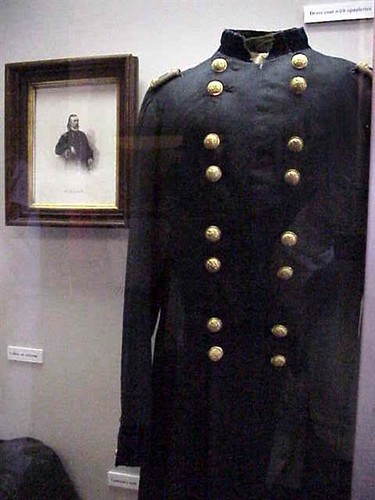
19th century Union frock coat once worn by
George Armstrong Custer
.  Photographed at
the 
Little Bighorn Battlefield National Monument
Visitors' Center, Crow Agency, Montana
by
©2005
Back in Feb 19, 2011, I posted a notice of an auction that offered a selection of military outerwear including a circa-1860 U.S. New York Regiment militia frock coat, enlisted man's gray with seven large New York state buttons down the front; a New York State 71st Regiment swallow-tailed full-dress dark blue jacket with a row of nine eagle buttons down the front; and a U.S. Louisville Legion-style wool frock coat, dark blue, with five Ohio buttons.  Auction notices have such a short shelf life that I probably shouldn't have created a blog post for that.  But, before deleting my original post, I thought about the variety of frock coats that had been sold and wondered about military decisions around uniform style during this period. So I decided to rewrite this post to provide some historical background on the military frock coat worn by officers in the 19th century and why this unform change was ultimately adopted.

"The first military frock coats were issued late in the Napoleonic Wars to French line infantry and Prussian Landwehr troops. Unwilling to soil the expensive tail coats on campaign, the French adopted a loose fitting single-breasted coat with contrasting collar and cuffs. The Germans, having been devastated by years of war, were unable to afford elaborate uniforms like the British line infantry and chose a peaked cap and double-breasted blue coat, again with contrasting collar and cuffs, as these were cheaper to produce for the large numbers of recruits, smart enough for full dress, and more practical for campaigns." - Wikipedia

So, the Wikipedia article points first to an unwillingness by the fastidious French to soil their tail coats as the reason for the adoption of the frock coat during the Napoleonic Wars.  Then it says the Germans followed suit because the frock coat was cheaper to produce in large numbers.

And I actually thought it was just a matter of staying in fashion with the civilian population!  So, thinking like the old budget officer I used to be, I had to find out whether such military decisions were actually a matter of style or practicality!  

First I had to back up a bit and look at the evolution of uniforms during this "revolutionary" period. Backing up to the colonial period, we find European armies wearing a justacorps-style coat.  The justacorps coat was a long knee-length coat introduced by the French in the late 17th century and worn throughout the 18th century.
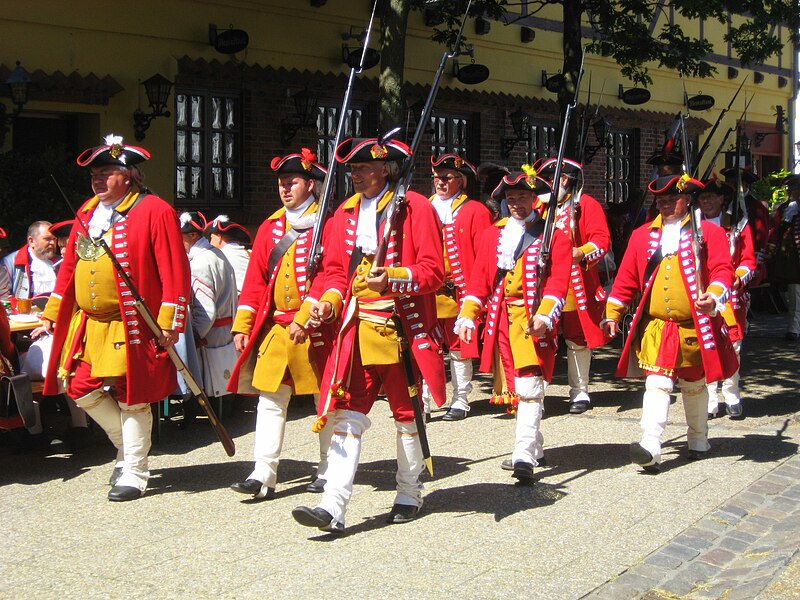
Justacorps military coats worn during the 18th century.
Photograph courtesy of   via Wikimedia Commons

 The justacorps featured a generous skirt. So economy of fabric could have been an issue if uniforms had evolved directly from the justacorps coat to the frock coat but that was not the case. During the Napoleonic Wars, a tight-fitting tailed coat was introduced, hence the reference to the French not wanting to soil their tailed coats.  The Americans followed suit during the War of 1812, introducing what was termed a coatee or shell jacket.  But here's where there appears to be a bit of confusion over the definition of a frock coat, despite the Wikpedia article's excellent references. 

"By the 1840s frock coats were regulation for the American, Prussian, Russian and French armies, although the British did not adopt them until after the Indian Mutiny. US army officers were first issued navy blue frocks during the Mexican War with gold epaulets and peaked caps of the German pattern. Enlisted USMC personnel received a double breasted version with red piping worn with a leather stock and shako to reflect their status as an elite unit, although infantry soldiers continued to be issued the 1833 pattern shell jacket until the M1858 uniform, complete with French style kepi, entered service shortly before the US Civil War." - Wikipedia
Image of 19th century coatee courtesy of the
According to the U.S. Army's own "Survey of Uniforms, Weapons, and Accoutrements", the uniform of the United States Army featured the short-tailed tight-fitting coatee until it was replaced by the frock coat in 1851.  These regulations were further reinforced in 1858 and 1860, establishing the frock coat as the regulation attire for Union soldiers.
"The regulations of 1858 and 1860 establish the uniform that defined the Union soldier in the American Civil War. The Army Hat in black felt with appropriate branch insignia; the frock coat with branch piping for foot troops, uniform jackets with branch colored lace for mounted troops, and sky-blue trousers." -  David Cole, Survey of U. S. Army Uniforms, Weapons, and Accoutrements.
So, getting back to the statement that frock coats were more economical, the amount of fabric does not appear to be the crux of the decision.  The coatee would have used less overall fabric than a frock coat.  But perhaps the expense of tailoring such a close-fitting uniform coupled with the body restriction and logistics of supplying large numbers in a variety of sizes offset fabric savings, especially since the cost of fabric dropped dramatically after the invention of the power loom by Edmund Cartwright in 1785 and its widespread adoption by the 1830s.  
But the frock coat was not without its detractors.  Shortly after the Civil War, Assistant Surgeon Alfred Woodhull conducted a study of army clothing with an eye to what improvements could be made to enhance the health and well being of each soldier.  Woodhull recommended a "Swiss blouse", a coat with four pleats running full length down the front of the coat to accomodate up to three wool shirts and a waistcoat in cold weather without hampering the freedom of movement.
But, alas, although this concept of layering was quite revolutionary, the coat was almost universally despised, especially by soldiers in the west. 
"The new uniform had not even been fully fielded before the Army began to make changes. Issue of the pleated blouse was stopped and the pattern 1874 sack coat was issued in its place. The new coat single breasted with five brass buttons in front and one on each cuff; it was made of dark blue wool with branch colored piping on each cuff and on the edge of the fall collar. 
The new coat was well received, but a new difficulty arose. On June 16, 1874 Congress, upon hearing that the Army was selling large quantities of surplus material, passed legislation that prohibited the expenditure of  appropriated money to purchase “hats, uniform caps, forage caps, uniform coats, uniform jackets, sack coats, and unlined coats…until those on hand known as the old pattern… were exhausted.” -  David Cole, Survey of U. S. Army Uniforms, Weapons, and Accoutrements.
So, it looks like uniform regulation was not a definitive decision based on style or practicality but a pendulum that swung periodically somewhere between the two with Congress stepping in from time to time when Washington watchdogs wanted to use government funding for something else.
Enhanced by Zemanta

Friday, October 22, 2010

Uncle Sam's Khaki Soldiers interesting article by D. L. Adams

My husband collects military vehicles and subscribes to Military Vehicles Magazine.  The last time I renewed his subscription, I did it online and signed up for their newsletter.  I've discovered that it often contains some really fascinating articles about different aspects of military history.


Today's issue had an in-depth article about the development of the khaki uniform, Uncle Sam’s khaki soldiers by D. L. Adams.


Harry Scofield, Battery E, 5th Artillery, is
wearing a woolen blouse with stand-and-fall
collar as specified in 1907 with “U.S.”
collar as specified for wearing during
1904-1910. John Adams-Graf Collection
During the Spanish-American War, several volunteer units were sent for tropical duty wearing lightweight cotton rather than the Army’s standard blue wool uniforms.  Following experiences in the Spanish-American War, the U.S. Army formally adopted khaki-colored uniforms.  It would only be a few years until it had all but abandoned the blue wool it had worn for more than a century.

As early as 1898, regulations specified a field service blouse for all commissioned officers and enlisted men to be made of “cotton drilling or khaki, light-brown in color…” This departure from the blue uniform, however, was only for the service uniform. While “on marches, fatigue duty, and ordinary wear,” troops were instructed to wear the blue wool surge, 5-button field blouse with rolled collar.-  Uncle Sam’s khaki soldiers by D. L. Adams.  
 Over the next nine years, the new khaki uniform underwent 10 specification changes including changes in the buttons.

The Army had worn bright brass or silver-colored buttons on its service uniforms from the beginning. This changed in 1902, however, with the adoption of a subdued, dull bronze button. The 1902 pattern General Service button featured the nation’s Great Seal with no rim around the circumference. It was produced in three sizes: Cuff, blouse and overcoat. The two smaller sizes were also produced in gilt for use on the dress uniform. The 1902 button would remain the standard pattern used on all of the Army’s dress and service uniforms until the adoption of a rimmed variant in 1912. Uncle Sam’s khaki soldiers by D. L. Adams.
The article is lavishly illustrated with images of different iterations of these uniforms.  I encourage you to check it out!


An Illustrated Encyclopedia of Military Uniforms of the 19th Century: An Expert Guide to the American Civil War, the Boer War, the Wars of German and Italian ... Colonial Wars (Illustrated Encyclopaedia of)   Eyewitness Visual Dictionaries: Military Uniforms   Vanished Armies: A Record of Military Uniform Observed And Drawn in Various European Countries During the Years 1907 to 1914 (Shire General)
Enhanced by Zemanta

Wednesday, October 8, 2008

U. S. Cavalry Museum

Fort Riley, Kansas (USA)

Originally called Camp Center, Ft. Riley was established in the 1850s to provide protection to immigrants migrating westward on the Oregon and Sante Fe Trails.

[Right: A cavalryman of the U.S.-Mexican War (1846 - 1848)]

Its cavalry units policed the Kansas Territory during the pro and anti-slavery bloodshed that preceded the Civil War and it was the last home of General George Armstrong Custer before he met his fate at the battle of the Little Big Horn.

The museum includes exhibits of cavalry activities from their early beginnings in the Revolutionary War up to their modern deployment in the Persian Gulf. It also features the work of outstanding military artists in both oil and bronze.

IMPORTANT: Ft. Riley is a secured military compound. To gain admittance to the base you must first stop and obtain a visitor's pass. You will be required to provide photo ID. Admission to the museum is free but donations are gladly accepted.

This statue (left) reminds me of "Comanche", the only representative of the U.S. Army left wounded but alive at the site of Custer's defeat near the Little Big Horn River in present day Montana.

I read a book about Comanche when I was a young girl and, being an avid animal lover, found the book very heart wrenching.

"You felt like you were somebody when you were on a good horse, with a carbine dangling from its small leather ring socket on your McClelland saddle, and a Colt army revolver strapped on your hip; and a hundred rounds of ammunition in your web belt and in your saddle pockets. You were a cavalryman of the Seventh Regiment. You were a part of a proud outfit that had a fighting reputation, and you were ready for a fight or a frolic." - Sgt. Charles Windolph in I Fought with Custer.

The famous Gatling Gun, designed by the American inventor Dr. Richard J. Gatling in 1861 and patented in 1862, was cranked by hand and could feed up to 1500 rounds per minute.

"Each barrel fires a single shot as it reaches a certain point in the cycle after which it ejects the spent cartridge, loads a new round, and in the process, somewhat cools down. This configuration allowed higher rates of fire without the problem of an overheating single barrel. The Maxim gun, invented in 1884, was the first self-powered machine gun. The first Gatling gun relied on a hand crank for external power. Some time later, Gatling-type weapons were invented that diverted a fraction of gas from the chamber to turn the barrels. Later still, electric motors supplied external power." - Wikipedia

In addition to weapons and firearms, the museum has an outstanding collection of period uniforms such as this panoply of a dragoon of 1833, who wielded the first "recognized"major cavalry sword produced in the early United States. It was patterned after an 1820 British saber.

Light Horse Harry" Lee, father of the famous Civil War General Robert E. Lee, led his cavalrymen, dressed like the soldier at right, in lightning swift raids during the American Revolutionary War. His unit captured over 400 British Soldiers in an attack on Paulus Hook, New Jersey.

I was surprised by the formal military attire of Apache scouts that included a horsehair topped helmet. Hollywood movies typically show them with castoff military jackets and bandana headwear resembling the portraits of Geronimo.

"Apache scouts (U.S. Army Indian Scouts) came from different Apache tribes or bands. Most of their service was in the Apache wars of the 1870s to 1890s, where they were the eyes and ears of the US military and sometimes the cultural translators for the various Apache bands and the US military. As was the custom in the US Military, scouts were enlisted with Anglo nicknames or single names.

"Chiricahuas were the most subordinate, energetic, untiring and, by odds, the most efficient of their command" (Crook Resume of Operations quoted in Conquest of Apacheria p 364). These scouts were sent to Florida by General Miles, along with those who they tracked for 16 months (1885-86), as if these Apache Scouts were hostiles to be punished. They were kept captive under nominal arrest as prisoners of war, along with the the rest of Geronimos band whom they'd helped the Army track down, for 26 years before finally being released." - Wikipedia